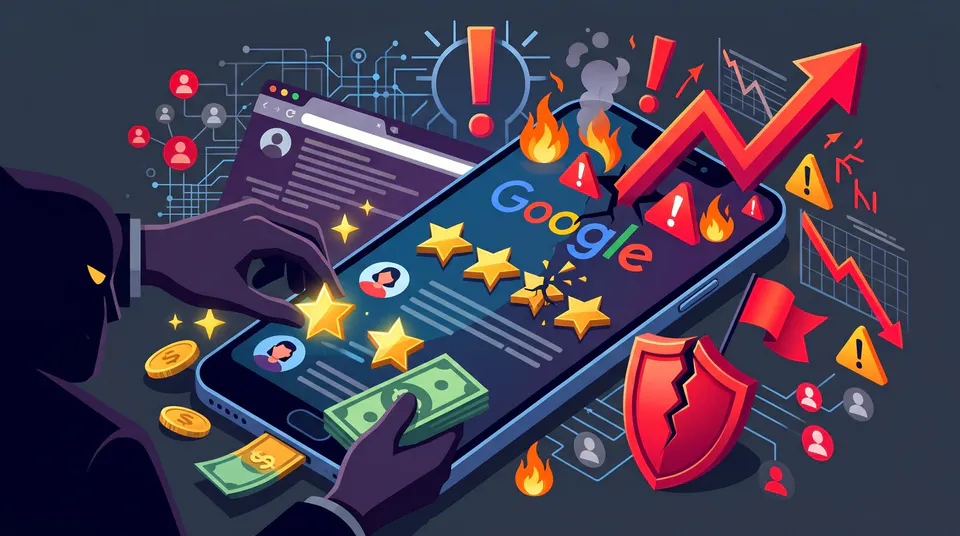
A business caught buying reviews used to lose the reviews it bought. That is no longer the worst case. Under commitments Google gave the UK's Competition and Markets Authority in January 2025, businesses that repeatedly post fake reviews have "all their reviews deleted for 6 months or more", have their review function switched off so no new ones can arrive, and carry prominent warning alerts on their Google profile telling customers what happened (CMA, via ICPEN). Years of legitimate feedback from real customers goes with the fakes.
That is the part most businesses buying reviews have not priced in. The downside is not a wasted budget. It is a profile that publicly announces it was caught, at the exact moment a customer is deciding whether to trust you.
What you are buying, and from whom
The market is larger and more industrialised than the phrase "buying reviews" suggests. Operations sell five-star reviews in bulk, fake Helpful votes to push reviews up a page, negative review campaigns aimed at competitors, and fake business listings created from scratch. Amazon has described brokers offering bulk discounts and guaranteed replacements if reviews get removed, and reaching sellers through websites, social media and encrypted messaging apps (Amazon).
The guarantee is the detail worth sitting with. A seller who promises to replace removed reviews is telling you, in writing, that removal is routine and expected. You are not buying a rating. You are renting one, from a supplier who has priced in how often it gets taken away.
Those suppliers are also under sustained legal attack. Amazon says it blocked over 275 million suspected fake reviews in 2024, has taken legal action against more than 150 operators, and has deactivated over 150 websites selling these services. Each takedown strands the customers who paid in advance.
Google's published policy is unambiguous about what counts as a violation. Content not based on a real experience, paid or in-kind reviews, and multiple accounts run by one person all fall under fake engagement, which the policy says "is not allowed and will be removed". Incentivised reviews are banned separately: a business may not offer payment, discounts or free goods in exchange for reviews, edits, or the removal of negative ones (Google).
The enforcement that followed the CMA undertakings is what changed the arithmetic. Three things now happen to repeat offenders in the UK:
- Every review is deleted, for six months or more. Not the purchased ones. All of them, including four years of honest feedback from customers who liked you.
- The review function is deactivated, so you cannot rebuild during the penalty. New customers who want to leave a review find they cannot.
- A prominent warning alert appears on the profile. The score is not merely gone. The space where it was now carries a notice.
Google also agreed to ban individuals who repeatedly post fake or misleading reviews about UK businesses, whether positive or negative, regardless of where those reviewers are based, and to report to the CMA on compliance over a three-year period. The detection effort is not winding down.
There is a second-order effect that businesses underestimate. Platforms remove fake reviews on a delay, sometimes long after they were posted, which means a campaign bought this quarter can take the profile down two quarters later, after the agency that sold it has been paid and moved on. We covered how that delayed clean-up works in do fake Google reviews expire.
The legal exposure now has a number on it
Until recently, buying reviews was a policy violation with commercial consequences. It is now a legal one with statutory penalties on both sides of the Atlantic.
In the United States, the Federal Trade Commission's Consumer Review Rule carries civil penalties of up to $53,088 per violation. In December 2025 the FTC sent warning letters to ten companies, six property management firms, three personal injury law firms and an accounting firm, over offering money or incentives such as lease discounts and gift cards in exchange for positive reviews (FTC). Note what that list has in common: these are ordinary local service businesses, not offshore sellers.
Two 2026 cases show the range of outcomes (DLA Piper):
- TruHeight, a supplement company, had reviews written by its own employees posing as customers and gave free product or discounts for five-star ratings. The final order in July 2026 included a $4 million judgment, suspended on payment of $750,000 because the respondents could not pay the full amount.
- Premium Home Service, sued by the FTC and the Illinois Attorney General in May 2026, allegedly created thousands of fake business listings and had employees, relatives and SEO contractors post five-star reviews to dilute genuine one-star ones. The case is pending.
In the UK, posting fake reviews, publishing undisclosed incentivised reviews, hiding negative reviews and presenting misleading star ratings have all been banned practices since April 2025 under the Digital Markets, Competition and Consumers Act. The CMA can impose fines of up to 10% of annual global turnover and, as of March 2026, was scrutinising 14 businesses under those powers, including a funeral provider whose staff were allegedly asked to write positive reviews and a food delivery brand that allegedly offered discounts for five-star reviews without disclosing it (A&O Shearman).
A percentage of global turnover is not a fine a marketing budget absorbs.
The grey zone that catches honest businesses
Most businesses penalised for review manipulation never bought a review from a broker. They did something that felt like good customer service.
The practices that count as violations:
- Incentives of any kind. A discount, a free upgrade, loyalty points, a prize draw entry, or a gift card offered for leaving a review. The incentive does not have to be conditional on the review being positive for it to be a problem on most platforms.
- Review gating. Surveying customers first and sending only the happy ones to your public profile. Google's policy prohibits selectively soliciting positive reviews and discouraging negative ones.
- Asking staff, family or friends. The FTC calls these insider reviews, and two of the enforcement actions above involved exactly this.
- Asking a customer to change or delete a review after you fixed their problem. Fixing the problem is correct. Asking them to edit the record afterwards is not.
- Paying an agency without asking how. If an agency promises a specific rating by a specific date, it is buying the reviews. The liability sits with you, not with them.
The line that is safe is narrow and clear: ask every customer, in the same way, without offering anything in return. Google's policy explicitly permits asking for honest feedback when nothing is offered for it. If you work with influencers or affiliates who mention your product, the disclosure rules are a separate obligation we covered in FTC influencer guidelines.
Even when it works, it does not work
Set aside enforcement for a moment and assume you get away with it. The purchased reviews still underperform, for three reasons.
Customers have already adjusted. In a survey of 1,002 US shoppers published in August 2026, 40.6% said they distrust reviews because they may be paid or incentivised, and 42.0% suspected reviews might be fake or AI-generated (Alchemer). A wall of five-star praise is read as a warning sign by a substantial share of the people it is meant to persuade.
The pattern is visible to anyone who looks. Bought reviews arrive in clusters, come from accounts with no history, and describe the category rather than the product. AI-written reviews skew heavily positive, with 74% giving five stars against 59% for human-written ones in a 2026 analysis of Amazon listings (Pangram). The shape of a manipulated rating spread is the first thing a careful shopper checks, as we set out in how to spot fake reviews online.
You also lose your own instrumentation. Reviews are the cheapest diagnostic a business has: they tell you which delivery partner is failing, which product line is disappointing people, which support agent fixes things. Dilute that feed with purchased five-star entries and you can no longer read it. The complaints that would have told you what to fix are now buried under noise you paid to create.
What to do instead
The boring answer outperforms, mostly because so few businesses do it consistently.
- Ask everyone, every time, the same way. Automated post-purchase requests sent to the whole customer list, with neutral wording and nothing offered in return. Volume from an unbiased ask is what builds a rating that holds up.
- Ask at the right moment, meaning after the customer has had the experience, not at checkout before the product has arrived.
- Answer the negative ones in public, specifically. A reply that names the problem and states what you did about it does more for a reading customer than three five-star reviews. Template responses pasted under every complaint do the opposite.
- Fix the repeated complaint. If the same failure appears in four reviews, that is a product or process problem with a known solution and a measurable payoff.
- Claim your profiles on independent platforms, including WebVouch, where reviews cannot be edited or removed by the business they describe. A rating you cannot manipulate is worth more to a customer precisely because you cannot manipulate it, and it is the kind of record that survives a platform's clean-up.